
Most property investors in Victoria still begin their search with Melbourne.
That is understandable. Melbourne is the state’s biggest property market, it carries stronger name recognition, and many investors naturally assume that buying in a capital city is the safer long-term move.
But in 2026, that assumption deserves a closer look.
Right now, the gap between Greater Melbourne and regional Victoria is creating two very different buying environments. Melbourne is more expensive, more competitive in many pockets, and often forces investors to compromise on the type of property they can buy. Regional Victoria, on the other hand, is generally more affordable, often produces better rental returns, and in a number of markets still gives buyers some room to negotiate.
For investors working with a fixed budget, that difference matters a lot.
Instead of stretching to afford a smaller, older, or more compromised property in Melbourne, some investors may now be in a position to buy a better-quality house in regional Victoria while also improving cash flow. In the current market, that combination is hard to ignore.
Why regional Victoria is getting more attention in 2026
The big shift is not just about lower prices. It is about what the same budget can actually buy.
Across Greater Melbourne, median house prices are sitting around $862,000, with median rents at roughly $580 per week. That puts gross yields at about 3.5%. In regional Victoria, median house prices are closer to $600,000, while median rents are around $495 per week, producing a stronger gross yield of about 4.29%.
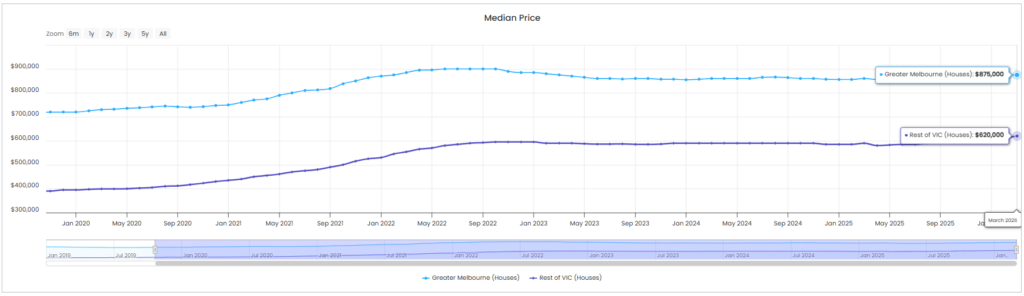
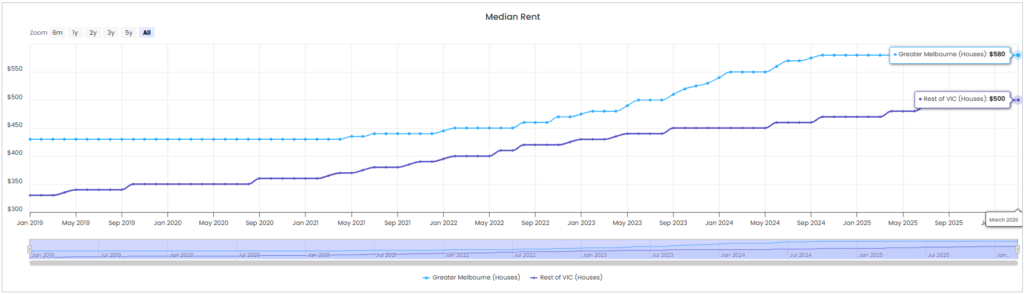
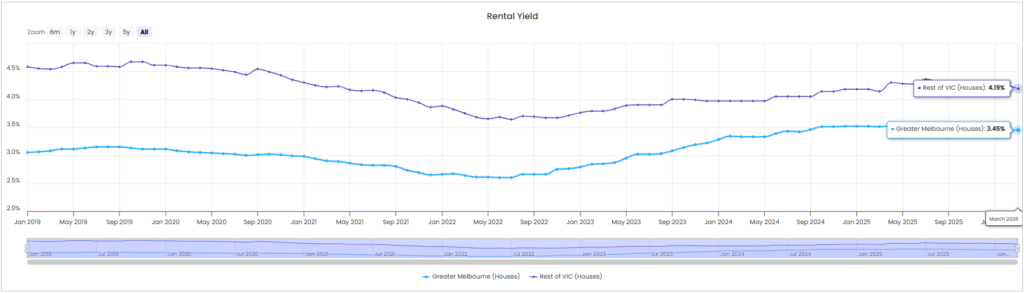
That changes the investment equation quite a bit.
A budget of $650,000 in Melbourne often pushes investors into compromise mode. That may mean buying a smaller home, an older dwelling, a property in a less desirable outer suburb, or moving away from houses and into townhouses or units simply to stay within budget.
In regional Victoria, that same $650,000 budget sits above the median in many markets. That gives investors more flexibility. It can mean a better-quality home, stronger land content, and an asset that appeals to a wider range of tenants, especially families.
The yield gap also matters more than many people realise. A difference of close to one percentage point in gross yield can mean several thousand dollars a year in additional rental income. That does not just help cash flow. It can also reduce holding pressure, improve serviceability, and make the property easier to keep through slower periods of growth.
For many investors, that is the real story in 2026. It is not simply that regional Victoria is cheaper. It is that it may currently offer a better overall balance between affordability, income, and asset quality.
Why this market setup matters right now
Higher yield on its own does not automatically make a market attractive.
There are plenty of locations that look good on paper because the yield is strong, but they do not go on to deliver much in the way of long-term growth. That is why investors need to look beyond one number.
What makes parts of regional Victoria more interesting right now is the mix of indicators appearing together.
In several regional markets, rental conditions still look relatively supportive while sales conditions remain softer. In simple terms, rents and yields are still holding up reasonably well, while homes are not always selling as quickly as they do in hotter, more competitive markets.
For investors, that can create a very useful window.
Supportive rental conditions help support income, while slower sales conditions can create more negotiating power. When those two forces show up at the same time, it can suggest a market worth closer attention.
That setup does not stay around forever.
If interest rates ease further and buyer confidence improves, many of these regional markets could become more competitive quite quickly. Once sentiment shifts and more buyers step in, the negotiation advantage often disappears.
That is why timing matters.
Good investors are not just trying to buy the right market. They are trying to buy the right market at the right stage of the cycle. That is often where the real edge is found.
Five regional Victorian LGAs standing out in 2026
The strongest opportunities are not spread evenly across the state.
When regional Victoria is filtered through key metrics such as median price, rental yield, days on market, vacancy pressure, and infrastructure investment, five LGAs stand out as particularly interesting in 2026.
These are not the only places worth researching. But for investors comparing affordability, cash flow, and future growth potential, they are some of the most compelling starting points.
Greater Bendigo
Greater Bendigo is arguably the strongest all-round performer of the group at the moment.
With a median house price around $610,000, gross yield at 4.26%, and days on market currently at 36 days, Bendigo is showing a very appealing mix of growth, demand, and liveability. It has not only recovered from its downturn, but also appears to be building renewed momentum.
That matters because markets that are strengthening across several indicators at once often deserve closer attention.
Infrastructure is again a major driver.
Hospital expansion, station upgrades, CBD improvements, and metro rail-related projects are improving connectivity and reinforcing Bendigo’s role as one of Victoria’s most important regional cities. These are not minor background details. They help shape employment, convenience, confidence, and future population attraction.
Units are also growing strongly, which suggests demand is broad-based rather than concentrated in just one part of the market. When that broader demand is combined with relatively fast sales conditions, it points to increasing competition and improving buyer confidence.
For investors looking for a regional city that offers solid yield, recent growth, and real depth, Bendigo stands out as one of the clearest regional growth city profiles in Victoria right now.
It is not the cheapest market on this list, but it may be one of the most balanced.
Greater Geelong
Greater Geelong continues to act more like a second-tier capital city than a typical regional market.
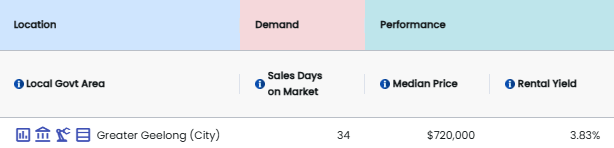
With a median house price around $720,000, a gross yield of roughly 3.83%, and days on market sitting around 34 days, Geelong offers a more mature and established profile than many other regional centres. The yields are not the strongest on this list, but Geelong makes up for that with scale, stronger long-term demand drivers, and a broader economic base.
Major road upgrades, rail improvements, hospital expansion, and large civic and commercial projects continue to support employment, population growth, and overall confidence in the city. Demand is also being driven heavily by owner-occupiers, which can help support price resilience over time.
That owner-occupier depth is important. Markets with strong owner-occupier appeal often hold up better because buyers are purchasing for lifestyle and long-term living, not just short-term returns.
For investors, Geelong is less about maximising short-term cash flow and more about positioning in a large regional city with strong lifestyle appeal, real depth, and long-term growth fundamentals.
It may suit investors who are more focused on capital growth than immediate yield, or those who want a regional market that feels more established and less volatile.
Ballarat
Ballarat is shaping up as one of the more balanced regional markets in Victoria.
The median house price sits around $585,000, gross yield is about 3.96%, and days on market are around 42 days. That puts Ballarat in an attractive middle ground. It is more affordable than Geelong, offers better income, and still has strong long-term growth drivers working in its favour.
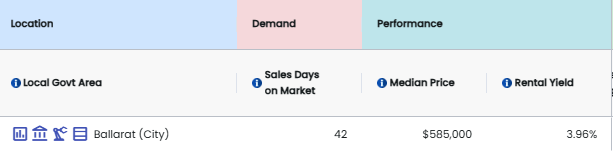
Recent price growth suggests Ballarat may already have moved past the bottom of its correction. House growth has been solid, while units have also performed strongly. That is encouraging because it suggests buyer demand is not isolated to one segment of the market.
Infrastructure continues to be a major part of the story here too.
Urban renewal projects, hospital redevelopment, and transport upgrades are helping improve liveability and make the city more attractive to both residents and investors. When a regional city continues to improve its amenity, accessibility, and services, it often strengthens both demand and confidence over time.
From a practical investor point of view, Ballarat also remains appealing because the budget still goes further.
In the $550,000 to $650,000 range, investors can still find quality houses in Ballarat. That matters. Buying a good asset matters just as much as buying in a good market. Too many investors focus only on the suburb name or the city headline and forget that the quality of the property itself still plays a major role in performance.
Ballarat continues to offer many buyers the chance to secure a better property without stretching their budget too far, and that is a meaningful advantage in the current environment.
Greater Shepparton
Greater Shepparton stands out as one of the stronger cash flow options on this list.
The median house price is around $510,000 on average between houses and units, with house yields at 4.86% and unit yields at 5.50%. Those are strong numbers in the current Victorian market, especially for investors focused on cash flow rather than just cheap buy-in costs.
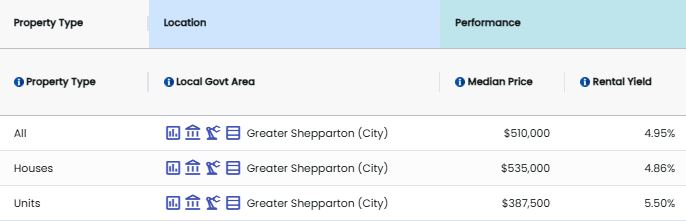
Over the past few years, Greater Shepparton has built a stronger profile than many investors might expect, particularly from a cash flow and affordability perspective. At the same time, days on market are longer, sitting around 66 days. That points to a buying environment that is less rushed and potentially more negotiable, which can work in an investor’s favour.
That combination is what makes the market particularly interesting.
Often, investors have to choose between cash flow and broader upside. A market may offer strong yield but little depth, or better growth credentials but weaker income. Shepparton appears to be offering a more practical balance than many people might expect.
Rental conditions are also improving quickly. Rent growth for both houses and units has been strong, which supports the case that this is not simply a low-priced market producing high yields by default. It is a market where rental demand looks to be strengthening in a meaningful way.
For investors who want stronger cash flow while still buying into a market with some broader upside, Greater Shepparton deserves a closer look.
Of course, that does not mean every suburb or every property in the LGA is automatically a good buy. Suburb-level filtering still matters. Stock selection still matters. But at a broad market level, Shepparton offers a compelling mix of affordability, income, and pricing flexibility.
Latrobe City
Latrobe City is the lowest entry point among the five LGAs, and arguably one of the most misunderstood.
With a median house price around $463,000, gross yield at 4.83%, and days on market sitting around 67 days, it offers a very different profile to places like Geelong or Bendigo. This is not a polished, mainstream regional city story. It is a transitional market, and that comes with both opportunity and risk.
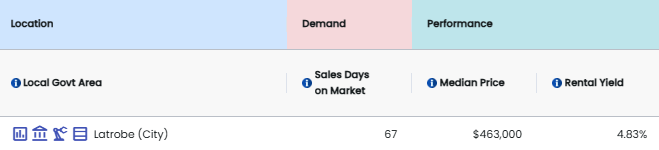
Latrobe City includes areas such as Traralgon, Moe, Morwell, and Churchill. The broader region is navigating structural change as it shifts away from coal-fired power generation and towards renewable energy and battery-related investment.
That transition creates uncertainty, but it can also create repricing opportunities.
Markets going through economic transition are not always straightforward. They require more care, more research, and a better understanding of local employment drivers. But they can also present value before the wider market fully re-rates them.
Despite the uncertainty, recent pricing has shown some resilience. Combined with the slower sales pace, that may suggest there is still room for investors to assess value carefully.
For investors who are comfortable with transition risk, Latrobe City can be worth serious consideration. It offers low entry costs, strong yields, and room to negotiate. But it is not a market to approach lazily.
This is the kind of area where understanding the local economy, the employment base, infrastructure commitments, and the differences between suburbs is absolutely essential. Investors who do the work may find value. Investors who rely on broad assumptions may get caught out.
The mistake many investors make when comparing Melbourne and regional Victoria
One of the biggest mistakes investors make is comparing locations by label instead of by outcome.
Melbourne sounds safer because it is a capital city. Regional Victoria sounds riskier because it is not. But that way of thinking can be too simplistic and, in some cases, costly.
The real comparison should be based on practical questions:
What quality of asset can a fixed budget buy?
What rent does that asset generate?
How competitive is the buying environment?
What does supply look like?
What infrastructure is supporting future demand?
Those are the questions that matter.
In some cases, the answers may still point to Melbourne. There are certainly parts of Melbourne that will continue to suit certain investors and strategies. But in many cases, especially for investors with tighter budgets, regional Victoria is currently offering a stronger overall equation.
Another common mistake is stopping at the LGA level.
An LGA can look very attractive in broad data, but the suburbs inside that market may tell very different stories. Some may have stronger owner-occupier appeal, tighter supply, and better household demographics. Others may have weaker demand, more investor concentration, or more compromised stock.
Strong research always needs to move from broad market selection down to suburb-level analysis and then property-level selection.
That is where better investment decisions are made.
How investors should research these markets properly
The best property decisions rarely come from relying on one metric in isolation.
Yield should not be assessed without looking at demand. Days on market should not be considered without looking at price point and buyer depth. Infrastructure should not be treated as an automatic growth guarantee without checking affordability, supply, and whether the project is genuinely funded and underway.
A stronger research process layers the data.
That means comparing median prices against rents, reviewing days on market, checking vacancy rates in regional Victoria, looking at recent growth, and understanding what infrastructure is actually happening on the ground. It also means testing each market against the investor’s real budget, borrowing capacity, and strategy rather than simply scanning medians and making assumptions.
This is where many investors go wrong. They read one headline, hear one hot tip, or focus on one attractive number and convince themselves a market is a good fit.
Better investors slow the process down.
They compare. They filter. They ask whether the numbers make sense together. They look for alignment between affordability, demand, cash flow, and future potential.
That is also why proper research tools can be valuable. A platform like SuburbsFinder helps centralise these comparisons, making it easier to move from broad market ideas to suburb-level filtering in a more structured and less emotional way.
Because in the end, the goal is not just to find a market that sounds good. It is to find one that fits the investor’s budget, risk tolerance, and long-term plan.
FAQ: Regional Victoria property investment
Is regional Victoria better than Melbourne for property investment in 2026?
Not in every case. But for many investors, especially those working with moderate budgets, regional Victoria is currently offering a better mix of affordability, yield, and negotiation room than Melbourne.
Which regional Victorian area offers the best cash flow?
Based on the figures discussed here, Greater Shepparton and Latrobe City stand out for stronger yields. That said, higher yield should always be assessed alongside demand, supply, and broader economic stability.
Which regional market looks strongest for long-term growth?
Greater Geelong and Greater Bendigo both present solid long-term growth cases, although for different reasons. Geelong offers scale and deeper owner-occupier demand, while Bendigo is showing a strong balance of yield, infrastructure, and market depth.
Are regional markets riskier than Melbourne?
They can be more variable, especially where employment is concentrated in fewer industries or where structural change is underway. That is why suburb-level research and understanding the local economy matter so much.
Should investors choose an LGA first or a suburb first?
Starting with the LGA can be a useful way to narrow the field, but final decisions should always happen at suburb level and then property level. A strong LGA does not automatically make every suburb inside it a strong investment.
Regional Victoria is no longer just the cheaper alternative to Melbourne.
In 2026, it is increasingly becoming the more strategic option for many investors. Lower entry prices, stronger rental returns, and softer sales conditions are combining to create a buying window that deserves real attention.
That does not mean every regional market is a winner.
What it does mean is that the old assumption that Melbourne is always the better place to start is becoming less reliable. Investors who continue to rely on that assumption may miss some very strong opportunities.
For buyers willing to compare markets properly, regional Victoria is offering more than affordability. It is offering choice, flexibility, and in some cases a better balance between cash flow and growth.
The next step is not to treat regional Victoria as one market. It is to go deeper into the specific suburbs within these stronger LGAs and work out which pockets still offer the best value before broader sentiment catches up.
That is where good research turns into good buying decisions. Start now and research regional Victoria suburbs with SuburbsFinder.

